Japanese Maples
 One of the most popular ornamental trees is the Japanese Maple Tree, or Acer Palmatum. For sale in a huge range of varieties (cultivars), from taller growing types (up to 5m depending on condition) to dwarf species that will reach around 1m. Many grafted types are available from specialist growers.
One of our favourites is Acer Palmatum disectum 'Seiryu' an upright green tree with finely dissected foliage that reaches around 4m with a classic vase like shape. For a smaller growing tree, Acer Palmatum 'Waterfall' has an attractive weeping habit and is an excellent choice next to a pond, or as a feature in the garden border.
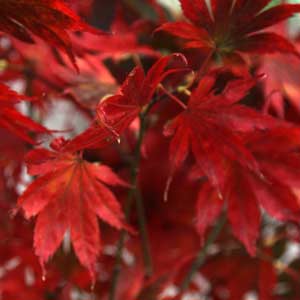
An excellent choice for brilliant red autumn foliage is the Japanese Maple pictured right 'Acer Palmatum Trompenburg'
Forms include both upright and weeping types, foliage in generally green or purple changing to reds and yellows in autumn when these beautiful trees put on a great display of color before winter.
Acer palmatum Atropurpureum 'Bloodgood' is an outstanding purple foliage form. Acer palmatum 'osakazuki' is an excellent choice for brilliant Autumn foliage. Acer griseum or the Paperbark Maple has an attractive peeling bark
Japanese Maple tree Varieties
With so many Japanese Maple cultivars available for sale, and in a range of sizes from bare rooted seedlings through to advanced specimens prices will vary greatly. It is best to select the characteristics you require before looking at individual cultivars so consider the following variations :
- upright or weeping
- heavily dissected foliage or broader leaves
- bark characteristics
- dwarf or normal size
- green foliage or purple
- autumn color
Japanese Maple Care
In general care of these plants is not difficult , they require a humus rich moist but well drained soil. Protection from the extremes of the hot afternoon sun and hot drying winds or strong coastal winds is preferable.
When planting, we suggest digging some well rotted compost and manure into the soil 3-4 weeks before, secure the young plant with a supporting stake which can be removed once the tree has established a good root system.
Newly planted maple trees can be watered in with a seaweed fertilizer which will help promote root growth.
Pruning Japanese Maples
Japanese maples need little to n o pruning, dead, damaged or diseased wood can be removed using a clean pruning saw
Growing Japanese Maple Trees in Containers
As many species are smaller growing, these wonderful trees are well suited to growing in containers, they will require some extra care. Watering will be needed during dry periods and fertilizer will be required each year during active growth, a slow release fertilizer ever 2 months is usually adequate.
Japanese maple trees are a favorite as a bonsai specimen.
Japanese maple trees are available fro sale from the following nurseries
CR?ġG FARM PLANTS
Bleddyn & Sue Wynn-Jones,
Telephone: (+44) 01248 670232
Griffiths Crossing, Caernarfon, GWYNEDD, LL55 1TU
We are a small nursery on the North Wales coast, which specialised in introducing new plants into cultivation, from seeds collected on our world-wide expeditions. Which include shade plants, climbers, species Hydrangea, Araliaceae, rare trees & shrubs, Convallariaceae, herbaceous & bulbous.
MILL HOUSE FARM
Longsight Rd, Copster Green, Blackburn, BB1 9EU.
tel 01254 248175 fax 01254 248333
We are a growers of ornamental trees , shrubs and hedging based in the ribble valley specialising in azaleas, maples, rhododendrons and eucalyptus together with a wide range of other rarities.
WEASEDALE NURSERIES Ltd
Newbiggin on Lune, KIRKBY STEPHEN, Cumbria, CA17 4LX UK
Telephone +44 (0)15396 23246 * Telefax +44 (0)15396 23277
Mail-order specialists and growers of bare-root hardy trees and shrubs at an elevation of 850 feet (260 metres) above sea-level since 1950.
CHEW VALLEY TREES
Winford Road Chew Magna Bristol BS40 8HJ
Tel: 01275 333 752
Includes: acer palmatum, acer platanoides, acer pseudoplatanus, acer rubrum, acer saccharinum, acer triflorum and others.